
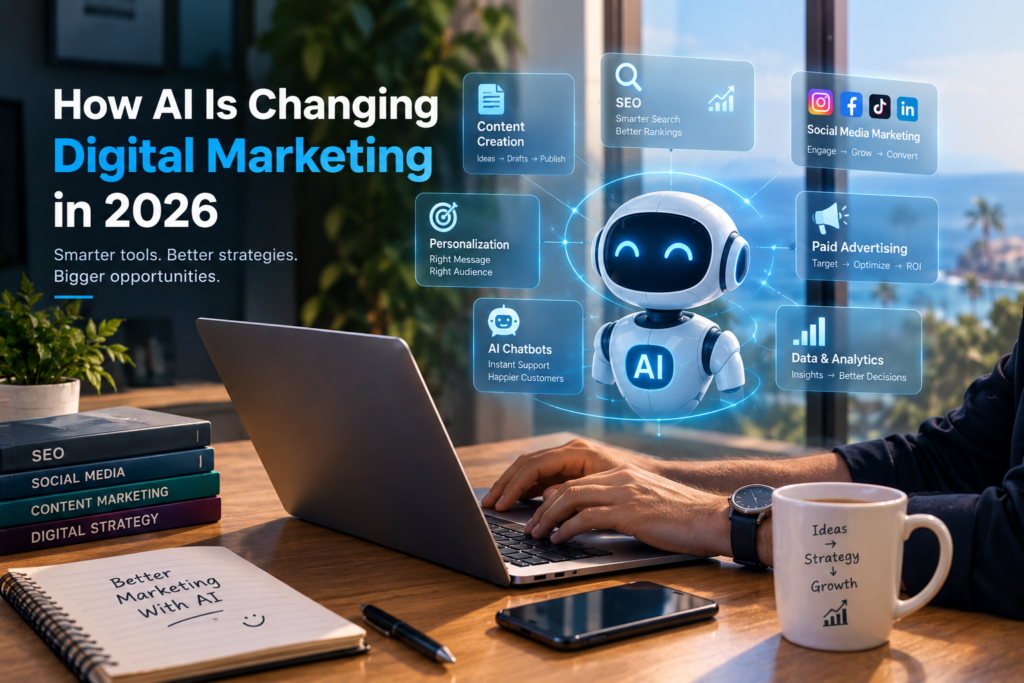
Artificial Intelligence (AI) has become one of the biggest developments in digital marketing. In 2026, AI is changing the way businesses create content, understand customers, improve SEO, manage social media, and run advertising campaigns.
AI is no longer just a future technology. It has become a practical tool that digital marketers can use to save time, understand data, and create better marketing strategies.
For businesses, adapting to AI can create new opportunities to reach the right audience and improve their online presence.
What Is AI in Digital Marketing?
AI in digital marketing means using artificial intelligence technologies to analyze information, understand customer behavior, automate tasks, and support marketing decisions.
AI tools can help marketers with tasks such as content creation, keyword research, customer analysis, advertising optimization, social media management, and performance reporting.
However, AI works best as a tool that supports marketers rather than completely replacing human creativity and decision-making.
1. AI Is Changing Content Creation
Content is an important part of digital marketing, and AI is making content creation faster and easier.
AI tools can help marketers generate ideas, create outlines, write drafts, improve headlines, summarize information, and adapt content for different platforms.
For example, a single blog topic can be transformed into:
- Social media posts
- Instagram captions
- Email content
- Video scripts
- Ad copy
- Short-form content
However, simply generating large amounts of AI content is not enough. Successful marketers still need to add their own experience, creativity, facts, opinions, and brand personality.
2. AI Is Changing SEO
Search engine optimization is also changing because of AI.
Search engines are becoming better at understanding the meaning and context of content. At the same time, people are increasingly using AI-powered search tools to find answers.
This means marketers need to focus on creating useful, trustworthy, and well-structured content instead of simply repeating keywords.
Traditional SEO remains important, but marketers are also paying attention to Generative Engine Optimization (GEO)—optimizing content so that it has a better chance of being understood and referenced by AI-powered search experiences.
3. Personalized Marketing
Customers expect businesses to provide relevant experiences.
AI can analyze customer data and identify patterns in customer interests, behavior, and interactions. Marketers can use these insights to create more personalized campaigns.
For example, AI can help businesses recommend products, personalize emails, segment audiences, and deliver more relevant advertisements.
Personalization can help businesses create stronger relationships with their customers when it is done responsibly and with respect for privacy.
4. AI-Powered Social Media Marketing
Social media marketers are also using AI to improve their workflow.
AI can help with:
- Content ideas
- Caption creation
- Content calendars
- Audience analysis
- Social listening
- Trend research
- Performance analysis
AI can save marketers time, but human creativity remains important. Social media users respond to content that feels genuine, relatable, and relevant.
5. AI in Digital Advertising
AI is changing how online advertising campaigns are created and optimized.
Advertising platforms increasingly use machine learning and automation to help marketers identify audiences, optimize campaigns, test creative variations, and allocate budgets.
Instead of manually managing every part of a campaign, marketers can use AI-powered tools to analyze performance and make optimization decisions faster.
The role of the marketer is therefore moving toward strategy, creative direction, testing, and interpreting results.
6. AI Chatbots and Customer Support
AI-powered chatbots are becoming an important part of customer communication.
Businesses can use AI chatbots to answer common questions, provide basic information, assist customers, and support them outside normal business hours.
For example, an online store can use a chatbot to answer questions about products, delivery, returns, and availability.
This can improve response times while allowing human employees to focus on more complex customer needs.
7. AI and Data Analytics
Digital marketing produces a huge amount of data.
AI can help marketers analyze this information more quickly and identify useful patterns.
Marketers can use AI-supported analytics to understand:
- Website traffic
- Customer behavior
- Campaign performance
- Conversion rates
- Audience interests
- Advertising results
These insights can help businesses make better marketing decisions based on data rather than assumptions.
8. AI Is Changing Email Marketing
Email marketing is also becoming more personalized with AI.
AI can help marketers create subject lines, suggest content, segment audiences, and identify suitable times for communication.
Instead of sending the same message to every customer, businesses can create more relevant campaigns based on customer interests and behavior.
9. The Importance of Human Creativity
Even with the rapid development of AI, human creativity remains extremely important.
AI can generate content and analyze information, but it does not automatically understand a brand’s complete identity, emotions, culture, or unique story.
The best approach is to combine AI efficiency with human creativity.
Marketers can use AI for research, automation, analysis, and idea generation while using their own skills for strategy, storytelling, creativity, communication, and decision-making.
10. The Future of Digital Marketing With AI
AI will continue to influence digital marketing throughout 2026 and beyond.
Digital marketers who learn how to use AI effectively can improve productivity and spend more time on strategic work.
The future is not simply about AI replacing marketers. It is increasingly about marketers who know how to use AI effectively.
Businesses that combine technology with strong branding, quality content, customer understanding, and human creativity will be better positioned to compete in the digital environment.
Conclusion
AI is transforming almost every area of digital marketing, from SEO and content creation to social media, advertising, analytics, and customer service.
For businesses, AI provides opportunities to work faster, understand customers better, and create more personalized marketing experiences.
For digital marketers, learning how to use AI responsibly is becoming an important professional skill.
As a Digital Marketing Specialist in Kollam, I believe the future of digital marketing will be a combination of technology, creativity, strategy, and human connection.
AI can provide powerful tools, but it is the marketer who decides how to use those tools to create meaningful results.
Ready to Grow Your Business Online?
If you are looking to improve your online presence with SEO, social media marketing, content marketing, or a customized digital marketing strategy, let’s connect and explore how digital marketing can help your business grow.